
Quick answer
A billiard club opening list should treat each table as a complete play station—table, light, cues, balls, racks and care tools—then add shared cleaning, spare-parts, storage, scoring and installation equipment. Define the table mix and room plan first so every item matches the playing format.
Start with the table mix, not the accessory count
Choose the games and customer groups before counting cues or lights. A venue built around American pool, Chinese 8-ball, snooker or mixed play requires different table sizes, balls, cloth, pocket geometry and cue equipment.
Record each proposed station on the floor plan. For every table, identify the playing format, nominal size, cue clearance, circulation aisle, spectator space, power requirement and service route. This prevents a visually attractive plan from failing at installation.
- Playing format and rule set
- Table size and approved model drawing
- Full cue-swing clearance
- Lighting position and power route
- Installation, leveling and future service access
Per-table equipment matrix
Use one repeatable checklist for every playing station. The exact quantity of house cues and spare items depends on venue capacity, damage rate and service plan, so it should be written into the opening budget rather than assumed.
| Station item | Decision to record | Acceptance check |
|---|---|---|
| Pool or snooker table | Model, size, slate or bed construction, pocket and return configuration | Drawing, finish reference and level test |
| Table light | Fixture footprint, mounting method, voltage and switch location | Even coverage without cue obstruction |
| Ball set | Game, diameter, markings and replacement cue ball | Correct set and undamaged surface |
| House cues | Length mix, tip size, rack capacity and spare plan | Straight shafts and serviceable tips |
| Racks and score tools | Triangle, diamond, templates, scoreboard or counters | Compatible with game and ball size |
| Care kit | Brush, cover, cloth care, ball cleaner and approved consumables | Staff instructions and storage point |
Shared club equipment that buyers often miss
Shared tools support uptime across the whole room. Plan secure cue storage, spare tips and chalk, cloth-care tools, a ball-cleaning routine, a level check method, fasteners, pocket parts and model-specific wear items.
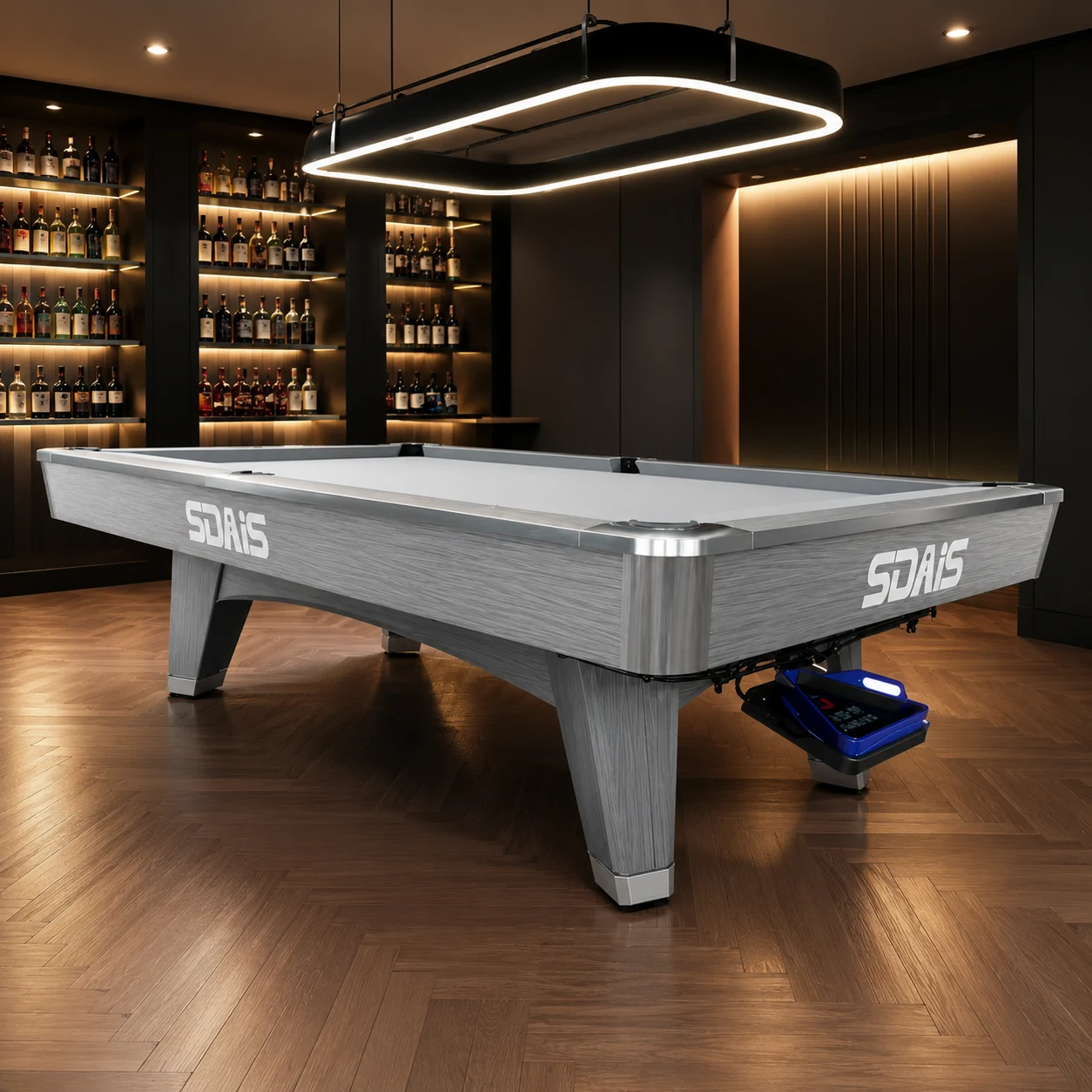
Ask the supplier to separate included accessories from optional club equipment. A photograph of a staged table does not prove that lights, balls, cues or cleaning tools are packed with the order.
- Wall or floor cue racks and lockable storage
- Ball cleaner or manual ball-care station
- Cloth brushes, covers and approved spot-cleaning tools
- Tips, chalk, pocket liners, fasteners and model-specific spares
- Assembly drawings, wiring notes and replacement-parts identifiers
Procurement sequence from floor plan to opening day
- Freeze the room plan, game mix and table quantities.
- Request model drawings, finish references and itemized accessory lists.
- Approve the sample or reference configuration, including logos and cloth colors.
- Confirm packing marks, unloading access and installer responsibilities.
- Inspect quantities, visible finishes, components and documentation before shipment.
- Level and commission every table, then record acceptance photos and spare-part locations.
Keep a station register after opening. Link each table to its model, installation date, cloth, ball set and maintenance history so repeat orders and repairs do not depend on memory.
Copy this opening-package inquiry
“We are opening a billiard club in [city, country]. The room plan supports [quantity] tables. Our intended mix is [games and sizes]. Please recommend models and provide a line-by-line quotation for tables, lights, balls, house cues, racks, care tools, spares, export packing and installation documents. Destination: [place]. Target opening date: [date]. Branding and finish references: [attach].”
Attach the floor plan and mark every door, lift, stair, column and power point. That information produces a more useful first answer than asking for a generic club package.