
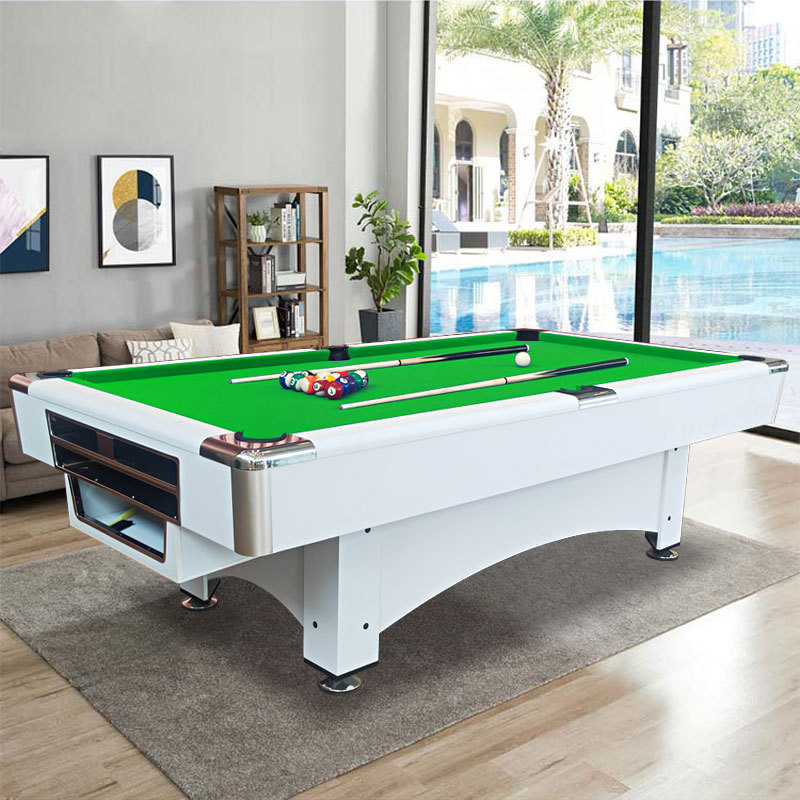
Choose 6 ft for space efficiency; choose 7 ft for a fuller compact-table game.
A six-foot model can solve a genuinely small room. A seven-foot format normally gives better cue-ball travel and a more familiar compact commercial experience. Before deciding, compare exact playfield dimensions and draw the cueing envelope for the room.
6 ft vs 7 ft comparison
| Decision factor | 6 ft table | 7 ft table |
|---|---|---|
| Primary advantage | Fits smaller rooms and multi-use spaces | More playing area while remaining compact |
| Playing dimensions | Not universal; request the exact drawing | A common example is 39 × 78 in, but verify the model |
| 58 in cue room example | 32 × 64 in playfield: 12 ft 4 in × 15 ft | 39 × 78 in playfield: 12 ft 11 in × 16 ft 2 in |
| Typical buyer question | Can it fit without short cues? | Does it match local player expectations? |
| Commercial planning | Confirm durability and game acceptance | Confirm service system, table spacing and throughput |
Room fit comes before the catalogue photo
Use the playfield-plus-two-cues formula on both axes. Then add practical space for a player to walk, seats, scoreboards, cue racks and service access. A table that technically fits may still create an awkward room if a column or sofa sits inside the backswing.
Playing experience
A smaller surface shortens shots and can increase traffic around clusters. A larger surface asks for more speed control and route planning. Neither description proves quality: flatness, cushion response, pocket geometry, cloth, balls and installation have a greater effect than appearance alone. Buyers should define the game and acceptable playing specification before selecting finishes.
Home, hotel or commercial venue?
- Compact home: prioritize honest room measurement, delivery access and noise.
- Hotel or villa: balance guest accessibility, finish durability and supervised maintenance.
- Bar or club: define the local game, ball management, revenue model, service access and spare parts.
- Dealer range: offer clearly separated compact and commercial choices instead of changing only the title.
Send one RFQ that makes comparison possible
Include the room drawing, intended game, target playfield, quantity, destination, expected daily use, finish, cloth, branding, accessories and required delivery date. Ask suppliers to return the same fields so price differences can be traced to specification instead of guesswork.
Use the formula, then confirm the selected model.
- World Pool-Billiard Association equipment specifications — official playing-surface terminology and competition formats.
- Sundays research and corrections policy — how specifications, calculations and commercial claims are separated.
Reviewed November 11, 2026. Dimensions shown as examples or planning calculations are not a substitute for the approved model drawing, room survey, local requirements or written quotation.