
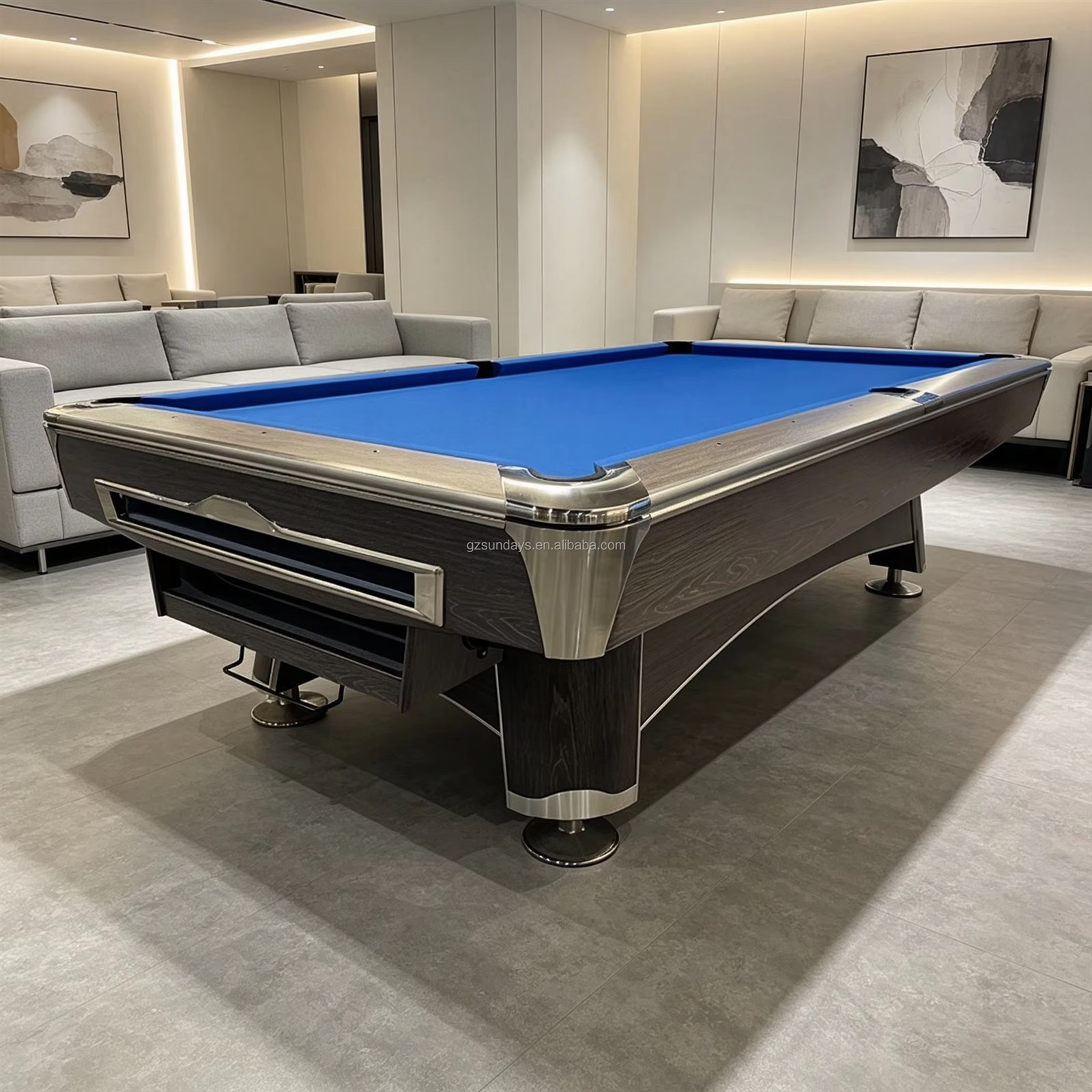
Buy the playing specification before the finish.
Use this order: game → room → playfield → construction → operating model → delivery and installation → finish → commercial terms. It prevents a visually attractive table from reaching a room where it cannot fit, play correctly or be serviced.
1. Name the game
| Format | Buyer priority | Common mistake |
|---|---|---|
| American pool | Table size, pocket format, ball size and intended rules | Comparing tables by outside length only |
| Chinese 8-ball / Heyball | Current rules reference and exact pocket/cushion drawing | Assuming every 9 ft table is the same format |
| Snooker | Full-size or smaller format, cloth direction, pocket and installation | Ignoring delivery weight and installation access |
| Pool dining table | Playing quality, dining height, top storage and leg clearance | Choosing furniture styling without testing both uses |
2. Prove the room fit
Calculate the cueing envelope from the playing surface. Add twice the cue length to the width and length, then draw every obstruction. Keep walking, seating and service space outside this minimum. Use the room-size calculator and compare the dimension hub.
3. Compare the build, not the marketing label
- Bed and support: material, thickness, section count, support points and leveling method
- Frame: material, jointing, cross members and access for installation
- Cushions: profile, rubber specification and replacement route
- Pockets: opening, shelf, liner, drop or return system
- Cloth: composition, speed, color, replacement and maintenance
- Hardware: finish, corrosion protection, fasteners and spare parts
Terms such as “professional,” “premium” and “solid” are not complete specifications. Ask for drawings, material descriptions, test or inspection records and model-specific photographs.
4. Match construction to use
A family room, rental property, hotel lounge, sports bar and training academy do not create the same load. Commercial buyers should specify expected playing hours, supervision, ball control, cleaning, cloth replacement, abuse risk and downtime tolerance. Home buyers should prioritize delivery route, floor loading, sound, climate and the realistic frequency of moving the table.
5. Define delivery and installation before paying
Write down who supplies unloading, inside delivery, assembly, leveling, cloth fitting, electrical work and waste removal. Confirm package count, packed dimensions, weights and access restrictions. A quote that stops at the port or curb is not the same as an installed table.
Use the delivery inspection checklist · Use the installation handover checklist
6. Compare quotes line by line
| Quote field | What must be explicit |
|---|---|
| Product | Model, playfield, cabinet, height, materials and included accessories |
| Commercial | MOQ, unit price basis, currency, payment, validity and Incoterm |
| Production | Sample approval, lead time, inspection point and change control |
| Logistics | Package count, gross weight, volume, loading and destination scope |
| After sales | Warranty process, evidence needed, parts route and response responsibility |
7. Ask for the evidence that matters
Request the current model drawing, approved sample record, bill of materials boundary, packing method, inspection plan, traceable product photographs and business identity. Evidence should support the exact model and order, not only prove that a factory owns equipment.
Use the formula, then confirm the selected model.
- World Pool-Billiard Association equipment specifications — official playing-surface terminology and competition formats.
- Sundays research and corrections policy — how specifications, calculations and commercial claims are separated.
Reviewed November 11, 2026. Dimensions shown as examples or planning calculations are not a substitute for the approved model drawing, room survey, local requirements or written quotation.